For the complete documentation index, see llms.txt
For the complete documentation index, see llms.txt
When Recruiters Must Manually Verify Identity for UK DBS Checks
*Common documents used in manual identity checks for a UK DBS criminal check include bank statements, utility bills, birth certificates, and driving licences — alongside a primary photo ID such as a passport.*
For a Standard or Enhanced DBS manual identity check, a valid passport plus a valid current driving licence is not enough on its own. Route 1 requires 1 document from Group 1 and 2 further documents from Group 1, Group 2a, or Group 2b. A passport can be the Group 1 document, and a current driving licence can count if it is listed and valid for the route, but the candidate still needs one additional listed route document. A deed poll or change-of-name deed does not count as that additional DBS route document. A UK or Channel Islands marriage/civil partnership certificate is different because it is listed as Group 2a and can count where the selected manual route allows Group 2a documents.
## Quick Summary
Zinc first attempts to verify a candidate's identity digitally under the UK Digital Identity and Attributes Trust Framework. If that fails, the organisation must complete a manual identity check before Zinc can submit the DBS application.
**Manual verification applies to all DBS applicants — including volunteers, not just employees.**
Organisations must retain a record of the documents checked for at least 2 years. This is a DBS compliance requirement.
---
## When Is a Manual Check Required?
Zinc will always attempt the digital route first. A manual check is required when the digital route cannot be completed, which typically happens because:
- There was a persistent issue with document quality (e.g. blurriness) that wasn't resolved after 6 resubmission attempts
- The candidate provided a UK birth certificate and proof of National Insurance, which are not eligible for the digital route
- The candidate could not provide the identity documents required for the digital process
- The candidate's digital address history could not be verified at their current address — if there are no digital matches at their current address, the identity check will fail even if the documents themselves are valid
- The candidate reached the reset limit for a name or date of birth mismatch on their identity check — three resets without a successful match moves the case to manual verification
When this happens, you'll see an **Attention Needed** status in Zinc and receive an email asking you to complete the manual review.
---
## How to Conduct the Manual Check
There are three options. Use Option 1 wherever possible.
**Option 1 — In-person (recommended)**
The candidate is physically present with their original documents. This is the default and preferred route.
**Option 2 — Live video, checker holds documents**
You hold the candidate's original physical documents while the candidate joins via live video. Use only where Option 1 is not possible.
**Option 3 — Live video, candidate holds documents**
The candidate holds their original documents on a live video call with you. This should only be used in cases of remote working or other exceptional circumstances. If you use Option 3, the documents must still be verified in person before the candidate starts employment — at the latest on their first day. The check is not complete until in-person verification has taken place.
---
## Your Organisation's Obligations
Regardless of which option you use, your organisation must:
- See the original physical documents (unless Option 3 applies — see above)
- Check the likeness, authenticity, consistency, and validity of the documents
- Confirm the documents belong to the applicant by comparing them with the candidate in person
- Record which documents were checked — either by keeping copies of the originals, or by making a clear written record of the document details
- **Retain that record for at least 2 years from the date the check was completed**
- Be able to evidence who performed the check, when, and how
> **Note on volunteers:** The 2-year retention requirement applies to all DBS applicants, including volunteers — not just employees. This is a DBS compliance requirement, not an employment law requirement, which is why it may not appear in general employment guidance. If your organisation works with volunteers, your document retention obligations are the same as for employed staff.
---
## Which Documents Are Acceptable?
The document groups (Group 1, 2a, and 2b) are the same regardless of DBS check type. The difference between a Basic DBS and a Standard or Enhanced DBS is the number of documents required at each route, and the availability of a third route for Standard/Enhanced checks.
### Document Routes
#### Basic DBS
You must use Route 1 where possible. Move to Route 2 only if the applicant cannot provide Route 1 documents, and only after a discussion with the applicant confirming there is a valid reason.
**Route 1**
- 1 document from Group 1
- 1 further document from Group 1, 2a, or 2b
- The combination must confirm the applicant's name and date of birth. If it cannot, a third document may be added.
**Route 2**
- 1 document from Group 2a
- 2 further documents from Group 2a or 2b
- The combination must confirm the applicant's name and date of birth.
If the applicant cannot meet Route 2 requirements, they cannot submit a Basic DBS application.
---
#### Standard or Enhanced DBS
You must use Route 1 where possible. Move to Route 2 only if Route 1 is impossible, and to Route 3 only if both Routes 1 and 2 are impossible.
**Route 1**
- 1 document from Group 1
- 2 further documents from Group 1, 2a, or 2b
- The combination must confirm the applicant's name and date of birth.
**Route 2**
- 1 document from Group 2a
- 2 further documents from Group 2a or 2b
- The combination must confirm the applicant's name and date of birth.
- The organisation must also use an appropriate external ID verification service.
**Route 3**
- 1 birth certificate issued more than 12 months after the time of birth (UK, Isle of Man, and Channel Islands)
- 1 document from Group 2a
- 3 further documents from Group 2a or 2b
- The combination must confirm the applicant's name and date of birth.
If the applicant cannot meet Route 3 requirements, they may need to be fingerprinted.
---
> **Important:** Name-change evidence is separate from the DBS identity-document route. A deed poll, change of name deed, or similar evidence can explain why names differ, but it must not be counted as one of the required Group 1, Group 2a, or Group 2b identity-route documents because deed poll/change of name deed is not listed in the Document Groups below. A marriage or civil partnership certificate is different: when issued in the UK or Channel Islands, it is listed as a Group 2a document and can count where the selected manual route allows a Group 2a document. For example, for a Standard or Enhanced DBS Route 1 check, a passport + utility bill + deed poll is not enough because the deed poll does not count as a route document.
### Counting Name-Change Evidence Versus DBS Route Documents
When deciding whether a manual Standard or Enhanced DBS document bundle is sufficient, count only documents that are explicitly listed in the DBS Group 1, Group 2a, or Group 2b route tables and allowed by the selected route. Name-change evidence is not automatically a route document.
- Deed poll, unenrolled deed poll, enrolled deed poll, change-of-name deed, and similar documents can explain why names differ, but they are not listed as Group 1, Group 2a, or Group 2b route documents. Do not count them toward the required manual identity-route document total.
- A UK or Channel Islands marriage/civil partnership certificate is different: it is explicitly listed as a Group 2a document, so it can count where the selected manual route allows a Group 2a document.
- For Standard or Enhanced DBS Route 1, passport + current driving licence is only two route documents and is not enough on its own. Passport + current driving licence + deed poll is also not enough, because deed poll does not count as the third route document.
- The applicant needs one more valid listed Group 1, Group 2a, or Group 2b document. A utility bill is one possible Group 2b document if it meets the issue-date and format rules, but it is not mandatory if another valid listed document is available.
- Passport + current driving licence + UK/Channel Islands marriage certificate can satisfy the document-counting part of Standard or Enhanced Route 1, provided the documents are original/valid, permitted for that route, and together satisfy the DBS name and date-of-birth checks. Do not treat deed poll as equivalent to marriage certificate for route counting.
### Document Groups
> Do not accept the foreign equivalent of an identity document if that document is listed as **(UK)** below.
#### Group 1: Primary Identity Documents
| Document | Notes |
|---|---|
| Passport | Any current and valid passport. A UK passport can be expired by up to 6 months. |
| e-Visa | Accessed via the View and Prove service. The applicant should request an 'immigration status' share code. If you don't have a UKVI account, you can create one at GOV.UK. |
| Biometric Residence Permit (BRP) | UK. A BRP showing Indefinite Leave to Remain, Indefinite Leave to Enter, or No Time Limit can be used up to 18 months past the BRP expiry date. BRP holders should be encouraged to create an account and access their eVisa. |
| Application Registration Card (ARC) | Issued by the Home Office. Must be checked against the Home Office Employer Checking Service. |
| Current driving licence photocard (full or provisional) | UK, Isle of Man, and Channel Islands. Must be current and valid. Note: the paper counterpart has not been valid since 8 June 2015. |
| Birth certificate — issued within 12 months of birth | UK, Isle of Man, and Channel Islands — including those issued by UK authorities overseas (e.g. embassies, High Commissions, HM Forces). Must be the original certificate. Certified copies are a Group 2a document. |
| Adoption certificate | UK and Channel Islands. |
#### Group 2a: Trusted Government Documents
| Document | Notes |
|---|---|
| Current driving licence photocard (full or provisional) | All countries outside the UK (excluding Isle of Man and Channel Islands). Must be current and valid. |
| Current driving licence — paper version (issued before March 2000) | UK, Isle of Man, and Channel Islands. Must be current and valid, and all information including name and address must be up to date. |
| Birth certificate — issued more than 12 months after birth | UK, Isle of Man, and Channel Islands. |
| Marriage/civil partnership certificate | UK and Channel Islands. |
| Immigration document, visa, or work permit | Issued by a country outside the UK. Valid only for roles where the applicant is living and working outside the UK. The visa/permit must relate to the non-UK country where the role is based. |
| HM Forces ID card or HM Armed Forces Veteran card | UK. |
| Firearms licence | UK, Isle of Man, and Channel Islands. |
#### Group 2b: Financial and Social History Documents
| Document | Notes | Issue Date / Validity |
|---|---|---|
| Mortgage statement | UK | Issued in last 12 months |
| Bank or building society statement | UK and Channel Islands. A printed statement stamped and signed by the bank is acceptable if hard copy statements are unavailable. | Issued in last 3 months |
| Bank or building society statement | Countries outside the UK. Branch must be in the country where the applicant lives and works. | Issued in last 3 months |
| Bank or building society account opening confirmation letter | UK | Issued in last 3 months |
| Credit card statement | UK | Issued in last 3 months |
| Financial statement (e.g. pension or endowment) | UK | Issued in last 12 months |
| P45 or P60 statement | UK and Channel Islands. Original only — cannot be an online document or PDF printout. | Issued in last 12 months |
| Council Tax statement | UK and Channel Islands | Issued in last 12 months |
| Letter of sponsorship from future UK employment provider | Valid only for applicants residing outside the UK at time of application. | Must still be valid |
| Utility bill | UK — not a mobile telephone bill. Cannot be printed from an online account. | Issued in last 3 months |
| Benefit statement (e.g. Child Benefit, State Pension) | UK | Issued in last 12 months |
| Central or local government / agency document giving entitlement | UK and Channel Islands — e.g. letters confirming PIP, free school meals, Universal Credit, asylum support. | Issued in last 12 months |
| HMRC self-assessment letter or tax demand letter | UK | Issued in last 12 months |
| European Health Insurance Card (EHIC) or Global Health Insurance Card (GHIC) | UK | Must still be valid |
| EEA National ID card | — | Must still be valid |
| Irish Passport Card | Cannot be used alongside an Irish passport. | Must still be valid |
| Cards carrying the PASS accreditation logo | UK, Isle of Man, and Channel Islands. Digital PASS cards are acceptable where issued by an approved digital PASS provider and the QR code has been used to confirm details. | Must still be valid |
| Letter from head teacher, college principal, or apprenticeship provider | UK — for 16–19 year olds in full-time education or an apprenticeship. For exceptional circumstances only, where no other documents can be provided. | Issued in last month |
---
## What to Look for During the Check
Full DBS guidance is available for [Basic DBS checks](https://www.gov.uk/government/publications/basic-check-guidance-and-policies/basic-check-id-checking-guidelines-from-22-april-2025) and [Standard and Enhanced DBS checks](https://www.gov.uk/government/publications/dbs-identity-checking-guidelines/id-checking-guidelines-for-standardenhanced-dbs-check-applications-from-22-april-2025).
In all cases, you are checking:
- **Likeness** — do the documents match the person in front of you?
- **Authenticity** — do the documents appear genuine?
- **Consistency** — do the documents agree with each other on name, date of birth, and other details?
- **Validity** — are the documents current and within any applicable expiry limits?
---
### Handling Name Discrepancies
If the name on a candidate's documents doesn't exactly match their application form, don't automatically reject the documents. The DBS expects you to ask the applicant for clarification and satisfy yourself that the discrepancy is legitimate. If you're satisfied it is, make sure all name variations are captured on the application form.
**Recent name changes (marriage, deed poll, or similar)**
If a candidate has recently changed their name, they may not yet have updated all their identity documents. This is acceptable, provided:
- The change can be evidenced — for example, by a marriage certificate or deed poll
- Both the old and new name are included on the application form, with "from" and "to" dates entered in ascending order
- You are satisfied the documents are genuine and the candidate's explanation is consistent
*Example:* A candidate has recently married and changed their surname but hasn't updated their passport. Their bank accounts are in their married name. They present their passport (pre-change name) alongside their marriage certificate, which evidences the connection between the two names. You've spoken to them and have no concerns about the documents or their responses. Both names are on the application form with accurate dates. You can proceed.
The DBS guidance doesn't set a specific timeframe for how recent the change must be — this is a judgment call. If the gap between the legal change and the check seems unusual, ask the candidate to explain.
This evidence explains the connection between names. It does not reduce the number of DBS route documents required. However, the document type still matters: a UK or Channel Islands marriage/civil partnership certificate is listed in Group 2a and can count where the selected manual route allows Group 2a, while a deed poll/change of name deed should not be counted as proof of ID for the manual identity route. First confirm the candidate has met the applicable Route 1, 2, or 3 document requirement, then use any name-change evidence to resolve the mismatch.
**Missing or additional middle names**
A driving licence may not include a middle name, particularly if it was converted from a paper to photocard licence. If you accept a document with a missing or additional name:
- Enter the applicant's full name (including the missing or additional name) as the current name on the application form
- Leave the previous names section blank if the name hasn't actually changed — the document just doesn't show it in full
**Spelling variations**
Minor spelling differences — such as an alternative spelling of a first name, or a missing hyphen — don't need to be entered as previous names unless the variation is materially different. Use the correct spelling as identified by the applicant. If the variation is significant enough to affect how records might be searched, enter it as a previous/other name.
**What to record**
For any name discrepancy you've resolved, note in your records that there was a discrepancy, what the candidate's explanation was, and that you were satisfied it was legitimate. Zinc's comments section on the candidate's report is a practical place for this.
---
## After the Check: What to Do in Zinc
Once you've completed the manual check, you must confirm this in Zinc:
1. Go to the candidate's report
2. Find the **Identity Verification** box
3. Click **I have verified their identity**
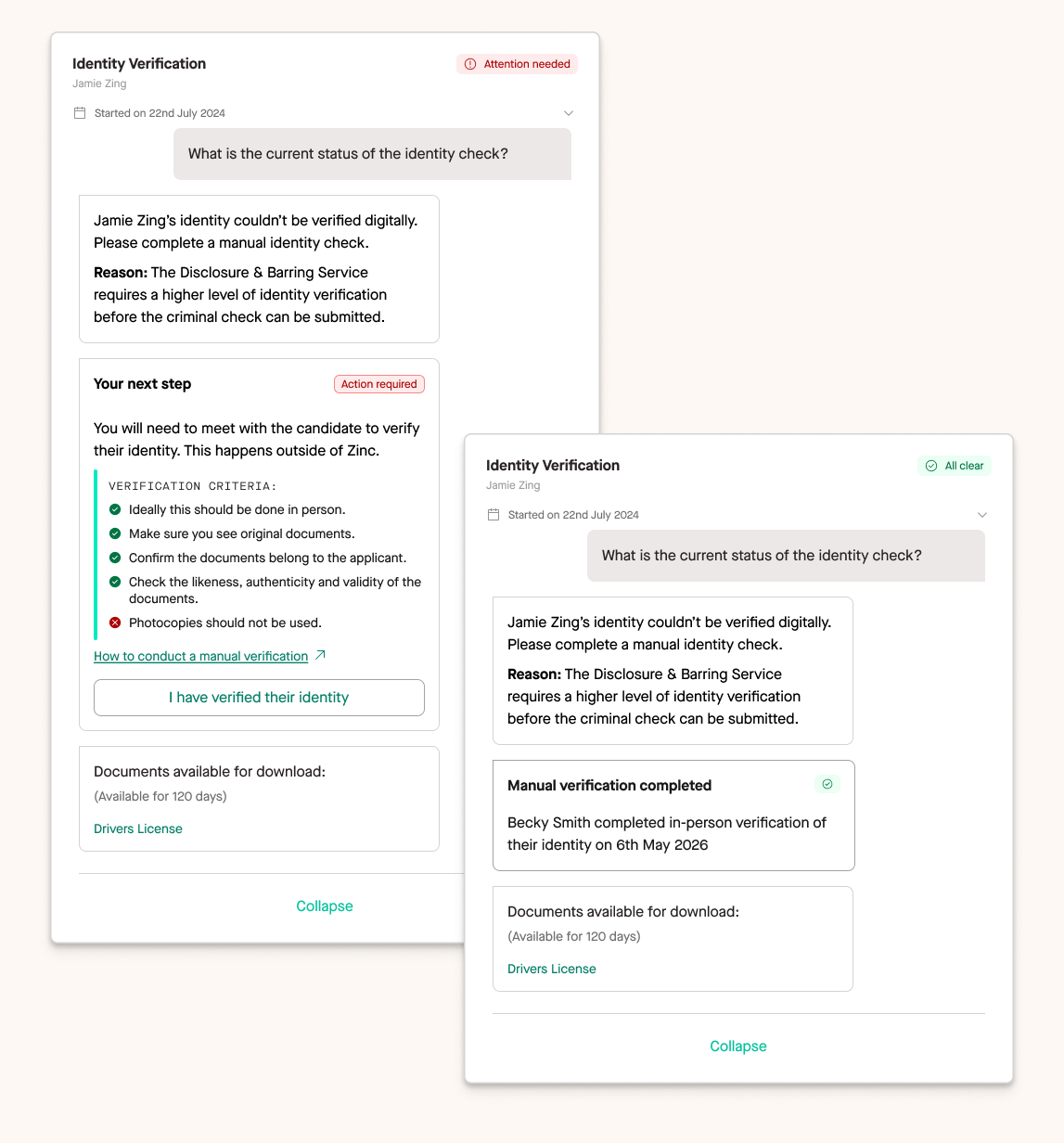
This creates an audit trail recording who completed the check and when. **The DBS application cannot be submitted until this step is done.** Once confirmed, Zinc will automatically proceed with submitting the application.
### If one person checks the documents and someone else clicks the button
- Zinc records the name of the team member who clicks **I have verified their identity**.
- You can separately record the name of a different team member who physically reviewed the documents in the comments of the candidate's report.
- If your organisation needs to show who physically inspected the documents (when different from the person who clicked in Zinc), keep an internal record like the comments section of the candidate's report so it can be audited.
---
## Frequently Asked Questions
**Does the manual check process apply to volunteers as well as employees?**
- Yes. The manual verification process — and all associated obligations including document retention — applies to all DBS applicants regardless of whether they are employed or volunteering with your organisation.
**Do we need to retain copies of the identity documents we check?**
- Yes. You must retain a record for at least 2 years from the date the check was completed. This can be copies of the original documents or a clear written record of the document details — but you must be able to evidence who performed the check, when, and how. This is a DBS compliance requirement.
**Why can't Zinc submit the DBS until I complete the manual verification step?**
- The DBS requires identity to be verified before an application can be submitted. Until you click **I have verified their identity** in Zinc, the application remains on hold. This step also creates the audit trail required for compliance.
**Can one team member check the ID documents and a different team member confirm in Zinc?**
- Yes — as long as your organisation keeps an auditable record of who physically verified the ID.
- Zinc will only log the team member who clicks **I have verified their identity**.
**How do we record the name of the person who actually did the manual check (if different from the person clicking in Zinc)?**
- We recommend using Zinc's comments section to record who actually did the manual check.
- Keep an internal record of the reviewer’s name, date, and relevant details for your compliance needs.
**What if the candidate cannot provide any of the required documents?**
- For a Basic DBS, if the applicant cannot meet Route 2 requirements, they cannot submit an application. For a Standard or Enhanced DBS, if the applicant cannot meet Route 3 requirements, they may need to be fingerprinted. Contact our Support Team if you are unsure how to proceed.
**Can I accept foreign versions of UK-only documents?**
- No. If a document is marked as **(UK)** in the document lists above, you must not accept a foreign equivalent.
**What is the difference between Option 2 and Option 3 for the manual check?**
- In Option 2, you (the checker) physically hold the candidate's original documents during a live video call. In Option 3, the candidate holds their own documents during the call. Option 3 carries an additional requirement: the documents must still be verified in person before employment or volunteering begins.